Welcome to the official website of Nanyang Huaye Explosion-proof Instrument Co., Ltd!
Service Hotline:0377-61613169 | E-mail: abc@huayex.com


SWBZ-2460 Non-explosion-proof temperature transmitter module
SWBZ-2460 temperature transmitter uses imported integrated circuits to amplify the signal of the thermal resistor and convert it into an output current of 4mA-20mA. The temperature transmitter has the following features: it can be directly installed in the sensor junction box, the signal is accurate, it can be transmitted remotely (up to 1000m), it has high precision, anti-interference, good long-term stability, and maintenance-free. This series of products has been widely used in various fields of industrial control.
Classification:
Detailed introduction
SWBZ-2460 temperature transmitter uses imported integrated circuits to amplify the signal of the thermal resistor and convert it into an output current of 4mA-20mA. The temperature transmitter has the following features: it can be directly installed in the sensor junction box, the signal is accurate, it can be transmitted remotely (up to 1000m), it has high precision, anti-interference, good long-term stability, and maintenance-free. This series of products has been widely used in various fields of industrial control.
1. Working Principle
The temperature transmitter converts the millivolt signal or resistance signal detected by the measuring unit into a voltage signal that can be accepted by the subsequent stage through the corresponding conversion circuit, and then converts it into a transmittable standard DC signal 4-20mA through signal processing (including nonlinear correction) and conversion unit (including range setting and zero point migration).
2. Technical indicators
1. Measurement range: -40℃~250℃
2. Measurement accuracy: 0.5 level
3. Temperature drift: 0.08mA/℃, annual drift 0.2mA/℃
4. Ambient temperature: -20℃~40℃
5. Power supply voltage: 24VDC±10% (explosion-proof products must be powered by a safety barrier)
6. Load capacity: 0~500 ohms
3. Use and calibration
a. Installation and wiring
The transmitter system connection is shown in the figure. The DC24V power supply supplies power to the transmitter through a shielded cable, "V+" connects to the positive pole, "V-" connects to the negative pole, and outputs 4-20mA current.
If the connection between the SWBZ transmitter and the thermal resistor exceeds 1 meter, a three-wire connection method should be used, with A connected to one end of the thermal resistor and B and C connected to the other end. Note that the connection should be firmly connected to the terminal to reduce contact resistance.
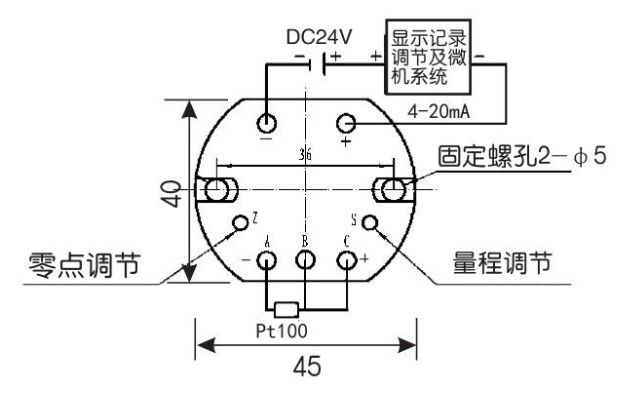
b. CalibrationConnect the transmitter to a standard signal source (or place it in an actual environment, using a standard thermometer as the standard), and repeatedly adjust the zero and full-scale potentiometers when the signal source gives zero and full-scale signals to accurately adjust the range. On the SBWZ transmitter, "Z" is the zero adjustment potentiometer, and "S" is the full-scale adjustment potentiometer. All potentiometers are calibrated before leaving the factory. During use, if errors occur due to the influence of ambient temperature or cold compensation is inaccurate, just fine-tune the zero potentiometer to correct them. This calibration method can also be used to correct system errors.
4. Notes
The power supply of the SWBZ-2460 series temperature transmitter must not have spikes, otherwise the transmitter is easily damaged. The transmitter should be calibrated 5 minutes after power-on, and the ambient temperature at that time should be paid attention to. The sensor housing should be firmly grounded when used in an environment with severe interference. The power supply and signal output should be transmitted using shielded cables, and the wire nuts should be tightened to ensure air tightness. The temperature transmitter cannot be corrected linearly due to circuit limitations. It is best to select the range according to the instructions to ensure its linearity. Pay special attention to the ambient temperature directly installed in the junction box, which should not exceed the range.
Key words:
* Note: Please be sure to fill in the information accurately and keep the communication unblocked. We will get in touch with you as soon as possible.
Nanyang Huaye Explosion Protected Instrument Co., Ltd.
Professional manufacturer of explosion-proof temperature meters and temperature sensors and suppliers of motor supporting instruments
Professional manufacturer of explosion-proof temperature instruments and temperature sensors, as well...
24-hour service hotline
Mobile:+86-15093007079 / +86-13838705322
Address: Middle Section of 3# Road, 2# Industrial Park, High-tech Zone, Nanyang City, Henan Province
E-mail:abc@huayex.com
Fax:+86-377-61613132

Copyright©Nanyang Huaye Explosion Protected Instrument Co., Ltd. This site already supports IPV6 Business License